MusicFlux: flexible conditioning for text-guided music generation and editing
A text-guided music editor built on a pretrained flow-matching text-to-audio model, unifying generation, inpainting/outpainting, and SFX restoration under one masked-conditioning formulation.
One model, three music-editing tasks
Music editing transforms an existing recording to meet a new objective while preserving the musical attributes outside the intended modification. Given the high cost of training music generators from scratch, MusicFlux adapts a single pretrained flow-matching text-to-audio model (TangoFlux) to generation and two forms of editing, under one shared conditioning formulation.
Text-to-Music Generation
Generates a full 30-second clip directly from a text caption — no source audio involved.
zeros tensor, mask m = 1 everywhere (fully generated).Inpainting / Outpainting
Regenerates a masked time span so it fits seamlessly with the audio around it, guided by a caption.
m = 1 inside the region to reconstruct, m = 0 elsewhere.SFX / Mastering Restoration
Cleans up a degraded recording — e.g. reducing reverb, fixing dynamics — following a text instruction.
m = 0 everywhere.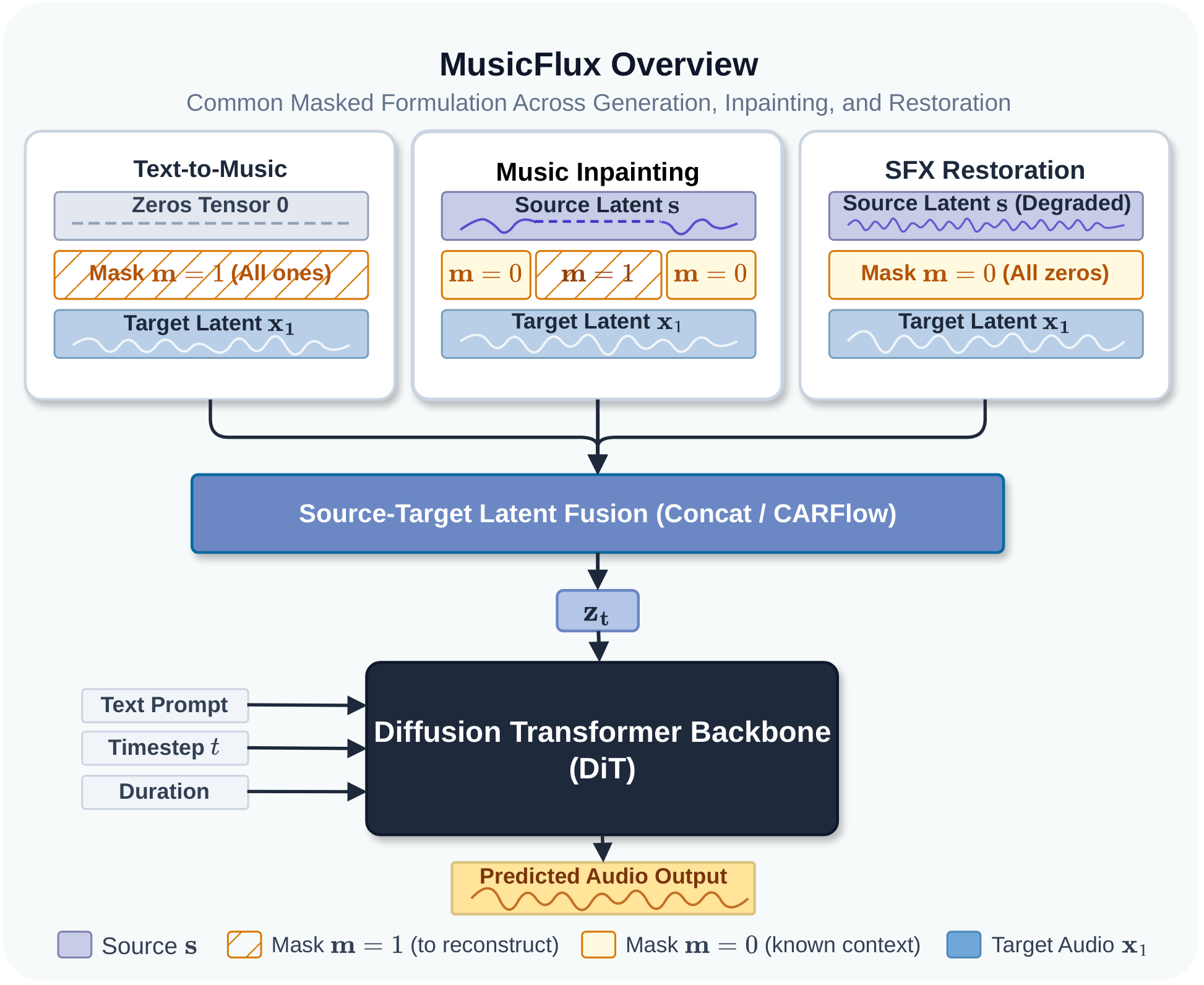
Fig. 1. MusicFlux formulates generation, inpainting, and SFX restoration under a shared latent-conditioning paradigm. The source latent s is the input audio to transform; a source-target latent fusion module combines (s, m, xt) into the trajectory zt fed to the diffusion transformer (DiT).
Audio examples
Real test-set outputs per task, comparing the ground truth / input against both MusicFlux conditioning strategies (and, for restoration, the SonicMaster baseline).
Goal: generate a complete 30-second music clip purely from the text instruction below — no reference audio is given to the model.
Goal: reconstruct a masked span of an existing track — given the instruction and the surrounding, unmasked context — so it blends in seamlessly.
Goal: clean up a degraded recording — e.g. excess reverb, poor EQ, low volume — by following a plain-language instruction, without altering its musical content.
How MusicFlux conditions on the source audio
MusicFlux fine-tunes TangoFlux, a flow-matching text-to-audio DiT, then explores two ways to condition it on source audio for editing — trading off editing quality against compute.
Background — Flow Matching
Learns a velocity field transporting a prior sample x₀ to data x₁ along a probability path. With rectified flow's linear interpolation:
Audio is generated by integrating the resulting ODE from noise to data.
Background — CAR-Flow
Reparameterizes the flow's source and target distributions with condition-dependent additive shifts, so the network only has to learn the remaining transport:
where y is the conditioning variable and μ₀, μ₁ are lightweight learned networks.
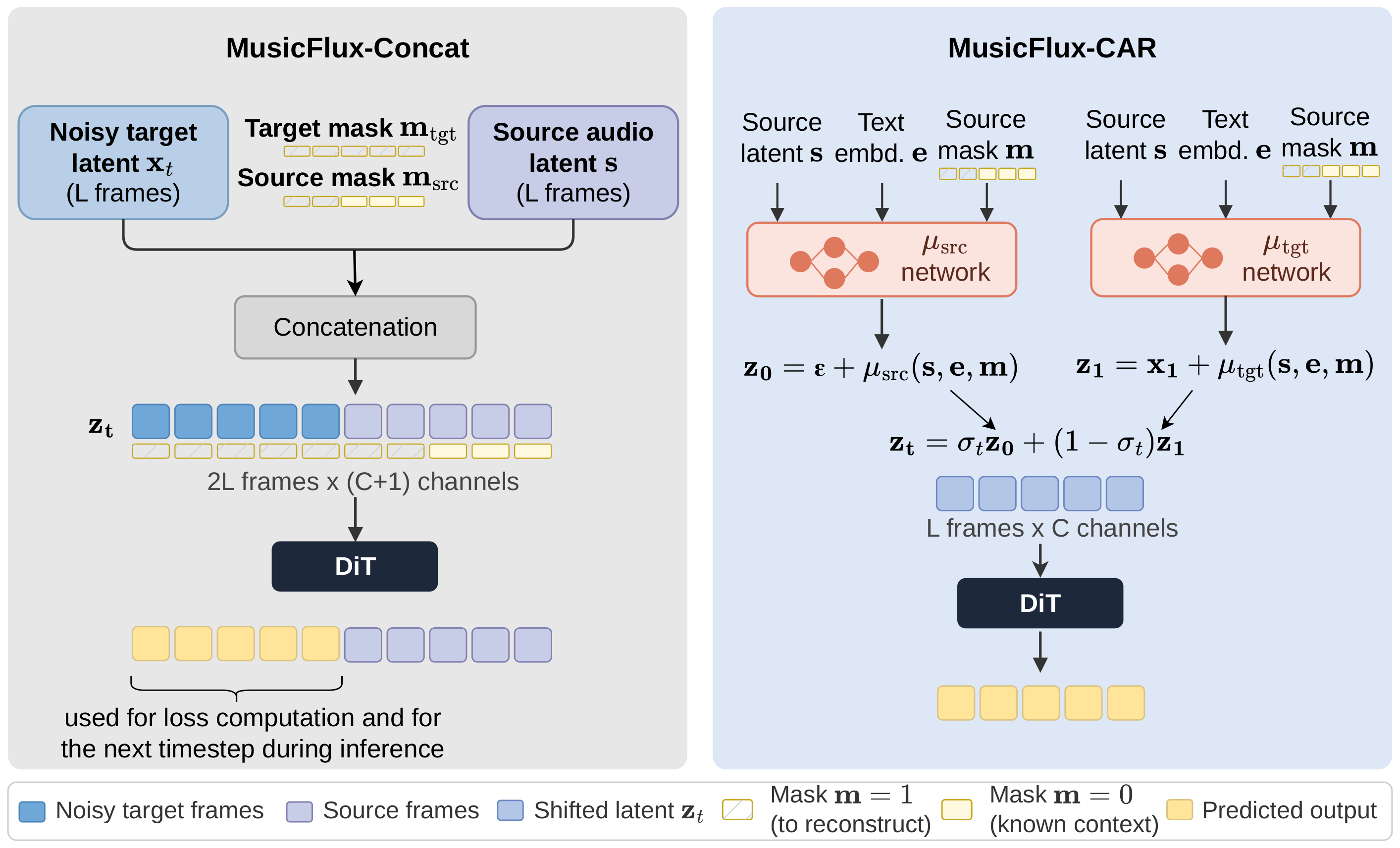
Fig. 2. (Left) MusicFlux-Concat: target and source latents concatenated along the sequence dimension (2L frames), mask concatenated along the channel dimension. (Right) MusicFlux-CAR: shift networks μsrc, μtgt shift the noise start-point and target endpoint; the DiT operates over the original L-frame sequence.
MusicFlux-Concat
Inspired by FLUX.1 Kontext: concatenate the source with the target so the Transformer attends to both directly.
- Source latent
sand noisy targetxtconcatenated along the sequence dimension, plus a mask channel:zt ∈ ℝB×2L×(C+1). - Distinct positional IDs per source/target token; full self-attention over 2L frames, loss computed on the target half only.
- One new
C → C+1projection — but doubles the attention sequence length.
MusicFlux-CAR
Inspired by CAR-Flow: pre-align the flow's endpoints with the conditioning signal via lightweight shift networks, instead of lengthening the sequence.
- Two Context Shift Networks μsrc, μtgt predict additive shifts from source audio
s, text embeddinge, and maskm:z₀=ε+μsrc(s,e,m),z₁=x₁+μtgt(s,e,m). - DiT runs on the original L-frame interpolant — same length as plain text-to-music.
- Zero-initialized output layer (training starts unshifted); adds only ≈4.6M params (<0.6% of the backbone).
To the authors' knowledge, the first application of CAR-Flow to audio editing and, more broadly, to time-series data.
Task-specific loss objectives
Both variants optimize a velocity-prediction MSE (ut = x₁ − x₀ for Concat, ut = z₁ − z₀ for CAR) over the full sequence for generation and SFX restoration. For inpainting/outpainting, the loss splits into a masked-region term and a down-weighted context term:
Reconstructing the already-known context is the easier sub-problem, so it is weighted down relative to the region that must be generated.
Datasets, setup, baselines & metrics
MusicFlux trains jointly on all three tasks, then is evaluated in- and out-of-domain against task-specific baselines.
JamendoMaxCaps (JMC)
Training + in-domain testInstrumental Jamendo audio captioned via Qwen2-Audio; 30-s segments, stereo, 44.1 kHz.
Song Describer Dataset (SDD)
Out-of-domain test (generation + inpainting)Openly licensed recordings with human captions; vocal tracks excluded for an instrumental-only subset.
SonicMaster-Test
Out-of-domain test (SFX restoration)Degraded variants across EQ, dynamics, reverb, amplitude and stereo effects, each with a restoration instruction.
Training setup
- Base modelTangoFlux (flow-matching DiT, FLAN-T5 text encoder)
- Transformer size6 dual-stream + 18 single-stream blocks, 8×128 heads
- ParametersMusicFlux-CAR ≈859M · MusicFlux-Concat ≈860M
- Max sequence645 latents ≈ 30 s @ 44.1 kHz (Stable Audio Open 1.0 VAE)
- Hardware3 × L40S GPUs, 4 epochs
- Batch size32 (CAR) / 16 (Concat), Adam, lr 2e-4
- Schedule2k-step warmup, cosine with 2 restarts
- Task samplingGeneration / inpainting / restoration, equal probability
- Context loss weightλctx = 0.1 (best on validation)
- Inference50 ODE integration steps, CFG scale 4.5
Baselines
Stable Audio 3 (small-music-base)
459M-param DiT + flow matching. Frozen T5Gemma text embeddings via cross-attention; context audio is projected and added to each block's hidden states. Trained on curated AudioSparx + Freesound (≈1.2M tracks).
SonicMaster
Text-conditioned rectified-flow restoration model; the degraded audio is the initial flow state, not an added conditioning signal.
Evaluation metrics
Text–audio alignment: CLAP similarity + FLEUR-based LALM assessment.
Kernel Audio Distance — MMD between CLAP embeddings of generated vs. reference audio.
Inpainting fit: Qwen3-Omni-30B rates 0–1 boundary continuity, timbre, loudness, ambience, rhythm, artifacts.
Distributional discrepancy between restored and reference audio.
Structural similarity between restored and clean mel-spectrograms.
Audiobox Aesthetics estimate of technical quality — clarity, dynamics, balance, spatialization.
Table 1 — Generation, inpainting & restoration results
| Model | Generation | Inpainting / Outpainting | Restoration | |||||||||
|---|---|---|---|---|---|---|---|---|---|---|---|---|
| JMC-Test | SDD | JMC-Test | SDD | SonicMaster-Test | ||||||||
| CAF ↑ | KAD ↓ | CAF ↑ | KAD ↓ | FLEUR* ↑ | KAD ↓ | FLEUR* ↑ | KAD ↓ | KAD ↓ | KL ↓ | SSIM ↑ | PQ ↑ | |
| Ground-truth (GT) | 0.5102 | 0.0000 | 0.5704 | 0.0000 | 0.8592 | 0.0000 | 0.8834 | 0.0000 | 0.0000 | 0.0000 | 1.000 | 7.7951 |
| Stable Audio 3 | – | – | 0.5593 | 2.8631 | – | – | 0.8248 | 1.4794 | – | – | – | – |
| SonicMaster | – | – | – | – | – | – | – | – | 0.1137 | 0.0009 | 0.5918 | 7.5310 |
| MusicFlux-Concat | 0.5100 | 0.6400 | 0.5213 | 4.5535 | 0.8340 | 0.0099 | 0.8428 | 0.0380 | 0.0489 | 0.0013 | 0.5702 | 7.5478 |
| MusicFlux-CAR | 0.5196 | 1.1239 | 0.4950 | 4.6687 | 0.8234 | 0.2496 | 0.8390 | 0.4744 | 0.2680 | 0.0015 | 0.5412 | 7.4044 |
Table 2 — Computational efficiency (batch size 1, sequence length 645, FP32)
| Stage | MusicFlux Method | Base memory (MiB) | Dynamic memory (MiB) | RTF |
|---|---|---|---|---|
| Inference | CAR | 3364.19 | 75.71 | 0.1188 |
| Inference | Concat | 3358.54 | 150.11 | 0.2203 |
| Training | CAR | 3372.48 | 1988.10 | – |
| Training | Concat | 3366.82 | 2748.19 | – |
RTF = real-time factor. "Base memory" is model instantiation; "dynamic memory" is additional memory used during execution.
What to remember
Unified framework
MusicFlux covers three music-editing settings — generation, inpainting/outpainting, and SFX restoration — in one framework.
Two conditioning strategies
MusicFlux-Concat achieves stronger editing performance; MusicFlux-CAR preserves the original sequence length and cuts inference runtime and dynamic memory by over 50%.
Competitive with specialists
Both remain competitive with task-specific baselines despite being single multi-task models trained on open data.
Fidelity vs. efficiency
The results highlight a trade-off between editing fidelity and efficiency; limitations in out-of-domain generalization and CAR conditioning motivate richer, more efficient conditioning in future work.